Build a business, not another project
An AI business builder should do more than generate a website. Locus Founder builds the offer and customer-acquisition system around it, then keeps operating the business after launch. It combines building, marketing, payments, and an approval-led operating loop; it is not a general-purpose app builder or a promise of revenue.
Updated on .
From one conversation to a working business
- Choose and validate the idea. Bring an idea or start from zero. The agent researches the market, challenges vague assumptions, and turns the direction into a concrete offer.
- Ship the public business. The agent creates the brand, builds the website, connects a domain, adds products or services, and wires payments into your own Stripe account.
- Go find customers. It builds prospect lists, runs approved outreach, creates ads, and records every lead and customer in the CRM.
- Learn and keep operating. The agent watches the results, drafts responses, and proposes the next useful move.
What is included
- Launch system: market research, offer, brand, custom website, domain, products, and checkout.
- Growth system: prospecting, personalized outreach, ad creation, lead tracking, and follow-up.
- Operating system: CRM, customer email drafts, payments, orders, analytics, and an ongoing work feed.
- Founder controls: approval gates, budget controls, pause controls, and ownership of every core asset.
Where an AI business builder fits
The label matters less than the job. Website and app builders produce a digital asset; workflow agents automate a process you already understand; an agency sells human labor. Locus is designed to connect the asset to an ongoing customer and operating loop.
| Category | Primary output | Work still owned by the founder |
|---|---|---|
| Chatbot | Answers, drafts, and advice | Execution and coordination |
| AI website builder | A website and hosting workflow | Offer, traffic, sales, and operations |
| AI app builder | Application code and deployment | Validation, distribution, and company operations |
| Workflow agent | Automation across an existing stack | Defining, supervising, and repairing the workflow |
| Human agency | Scoped work delivered by a services team | Briefing, approvals, and work outside the contract |
| Locus Founder | Website, acquisition work, CRM, and payments | Direction and approval of consequential actions |
For a sourced market comparison, read the best AI business builder guide.
Costs, approvals, and ownership
| Decision | How Locus works |
|---|---|
| Subscription | $25 monthly or $250 annually, charged when you subscribe; no trial or automatic enrollment. |
| Variable spend | Ads, domains, and third-party services are separate and require the applicable budget or approval. |
| Payments | Sales go through the founder's connected Stripe account; Stripe processing and a 1% Locus application fee apply. |
| Approval model | Customer messages, ads, prices, and charges wait for founder approval before they reach a customer. |
| Ownership | The founder keeps the domain, content, customer relationships, and connected payment account. Locus does not take equity. |
See the current fee schedule, security architecture, and service terms before deciding.
Product evidence from the build workflow
These are product walkthrough artifacts from a TrailHound demo workspace. They show the interface and approval flow; they are not a claim that TrailHound is a customer or that it earned revenue.
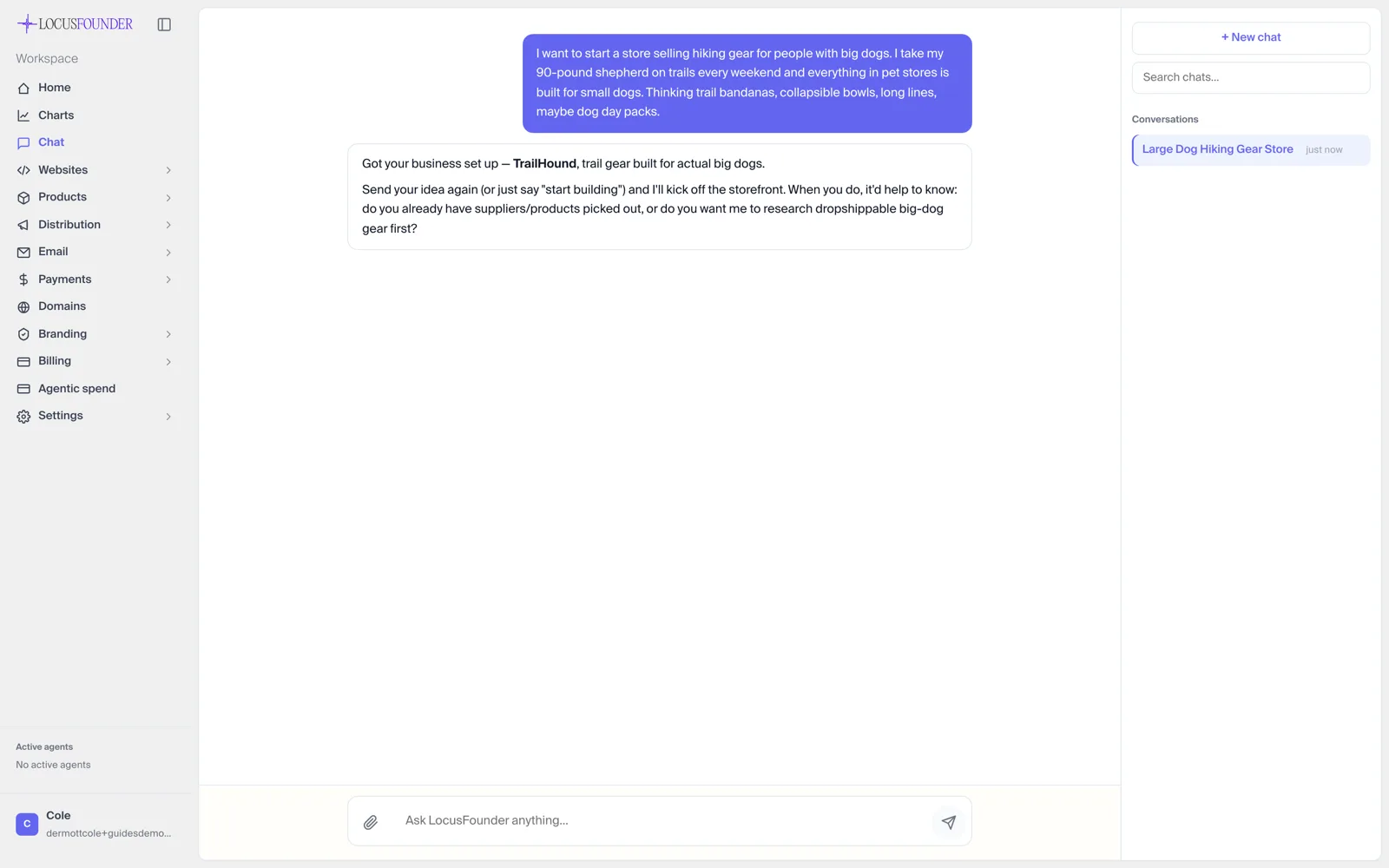
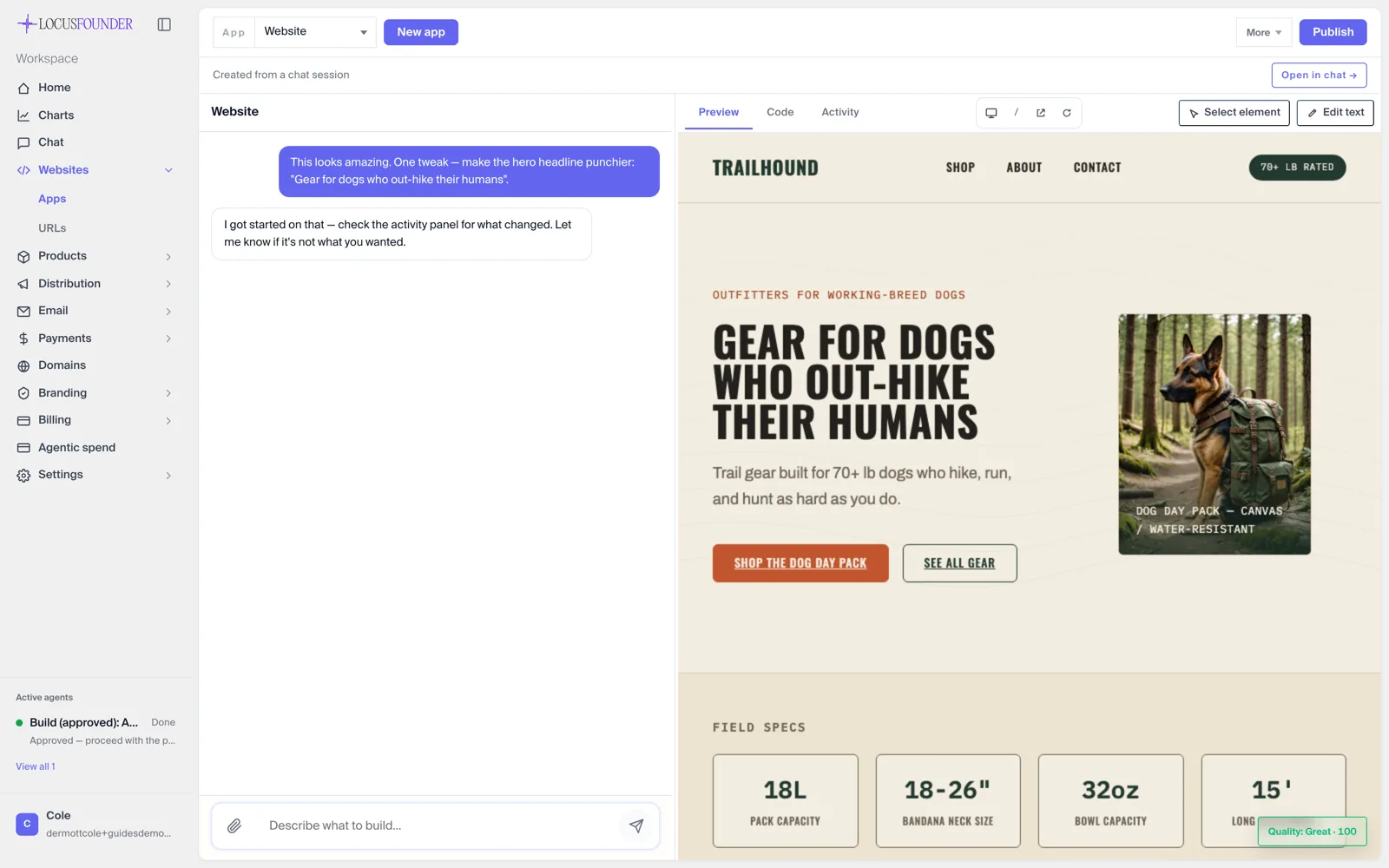
Visual transcript for the silent product walkthrough
A silent product walkthrough opens on a demo workspace dashboard and daily briefing. It then shows a revenue-and-spend chart and lead pipeline containing illustrative demo data. The pointer inspects the chart before the view reaches the demo business card and recent agent activity. This is product evidence only; the displayed demo data is not a customer result.
- 0:00–0:04 — The demo workspace opens on a dashboard and daily briefing.
- 0:05–0:13 — A revenue-and-spend chart and a lead pipeline summarize the demo business state.
- 0:14–0:19 — The pointer inspects the chart while the pipeline stays visible.
- 0:20–0:23 — The view reaches the demo business card and its recent agent activity.
The longer build guide shows the rest of the walkthrough, including products, checkout, leads, outreach drafts, and founder questions.
What Locus does not promise
- It does not guarantee customers, revenue, profit, or a successful market.
- It is not a substitute for a lawyer, accountant, tax professional, or regulated-industry expert.
- It is not a full engineering organization for complex custom software or an enterprise commerce stack.
- It cannot execute outside the connected tools, available budget, channel rules, and founder approvals.
Use the ordered launch guide to decide which work should be automated and where human advice is still required.
Follow the underlying evidence
The built-with-Locus showcase records public deployments and states what they do not prove. Consent-reviewed case studies and privacy-reviewed research publish only after their evidence gates pass, while Locus Live shows anonymized agent activity as it happens. For the full setup flow, read how to build a business with Locus Founder.
Common questions
What is an AI business builder?
An AI business builder turns a plain-language idea into the systems needed to launch and sell: an offer, website, domain, outreach, advertising, customer pipeline, and payments.
How is this different from an AI website builder?
An AI website builder stops after generating pages. Locus Founder treats the website as one step, then works on customer acquisition, follow-up, operations, and payments.
What kinds of businesses can Locus build?
Locus is designed for internet businesses such as services, digital products, simple ecommerce stores, lead-generation businesses, and content or subscription offers.
Do I need a business idea before I start?
No. You can bring an idea or ask the agent to research options around your experience, interests, budget, and goals before anything is built.
How much does Locus Founder cost?
Starting onboarding is free and does not require a card. Founder Monthly is $25 per month and Founder Annual is $250 per year; you are charged when you subscribe, with no trial or automatic enrollment. Paid advertising, domains, third-party services, Stripe processing, and the 1% Locus application fee are separate where applicable.
Does the AI business builder run marketing?
It can research prospects, prepare personalized outreach, create ad campaigns, track leads, and draft follow-up. Customer-facing messages, ads, prices, and charges remain behind founder approval and depend on the channels you connect.
Who owns the business and customer relationships?
The founder does. Your domain, content, customer relationships, and connected Stripe account remain yours. Locus provides the software and execution layer rather than taking equity or ownership of the business.
What does Locus Founder not do?
Locus does not guarantee customers or revenue, replace legal, tax, or accounting professionals, or serve as a full engineering team for complex custom software. It is designed for practical internet businesses whose work fits its connected tools and approval controls.